.png)


Commercial Lock Upgrade Guide for Business Owners

A back door that no longer latches, keys that have changed hands too many times, or a front entrance with visible wear can turn into a security issue long before a break-in occurs. This commercial lock upgrade guide helps business owners, property managers, and facility operators make sensible improvements without replacing hardware that still serves a purpose.
The right upgrade depends on your building, daily traffic, employee turnover, insurance requirements, and the items you need to protect. A small office, retail shop, medical practice, warehouse, and multi-tenant commercial property do not need the same hardware or access plan. The goal is to close real security gaps while keeping entry convenient for authorized staff and customers.
Start With How Your Building Is Actually Used
Before selecting a lock, look at each opening and ask a practical question: who uses this door, when do they use it, and what happens if it is compromised? The answer is often more useful than choosing hardware based on appearance or price alone.
Your main public entrance may need dependable commercial-grade hardware that stands up to constant use. A staff-only entrance may require stronger key control or electronic access credentials. A rear delivery door may need a heavy-duty deadbolt, reinforced strike plate, door closer adjustment, and better exterior lighting. A server room, pharmacy storage area, cash office, or tool cage may call for restricted keys or access control with an activity record.
Do not focus only on the lock cylinder. A strong lock installed on a loose door frame, damaged door, or weak strike plate can still be defeated. Check hinges, latch alignment, door closers, frames, glass near the lock, and the condition of the door itself. In many service calls, the problem is not that the lock is poor quality. It is that the hardware is misaligned after years of daily use.
Identify High-Risk Doors First
Most businesses do not need to upgrade every opening at once. Start with exterior doors, doors leading from shared areas into your suite, receiving entrances, and any room containing cash, inventory, records, medications, equipment, or confidential information.
Also consider doors that are frequently propped open because they are inconvenient to use. A secure lock has little value if employees bypass it to make deliveries or take out trash. In that situation, a door operator, access control reader, properly adjusted closer, or revised workflow may solve the underlying problem better than another mechanical lock.
Choose the Right Type of Commercial Lock Upgrade
Mechanical locks remain a reliable and cost-effective choice for many commercial spaces. A commercial lever lock or deadbolt with quality hardware can provide years of service when it is correctly specified and maintained. The upgrade becomes more significant when you improve key control, reinforce the opening, or move from residential-grade hardware to commercial-grade components.
Restricted or high-security key systems are useful when controlling copies is a concern. Standard keys can be copied easily, sometimes without the owner's knowledge. A restricted keyway gives the business more control over who can authorize duplicates. This is especially valuable for offices with staff turnover, property managers overseeing multiple units, and facilities where one lost key could expose several areas.
Electronic access control is often the better choice when access needs to change frequently. Instead of collecting keys after an employee leaves, an administrator can disable a credential. Staff can be assigned access by time, door, or role. Some systems can record entry activity, which can help with investigations and operational oversight. The trade-off is a higher initial investment, ongoing administration, and the need to select hardware that works with the door, fire code requirements, and building operation.
For many businesses, a hybrid approach works best. Exterior and sensitive interior doors can use electronic access, while low-risk storage rooms or utility areas remain on a properly controlled mechanical key system.
Do Not Overlook the Door and Frame
A lock upgrade should include a conversation about the strike and frame reinforcement. The strike is the metal plate that receives the latch or bolt. On a high-use or high-risk door, longer screws anchored into the framing and a reinforced strike can make a meaningful difference.
Panic hardware, exit devices, and fire-rated openings require particular care. These doors must allow safe exit and may have labeling or code requirements that limit what can be changed. Adding an aftermarket deadbolt or modifying hardware without proper evaluation can create a safety problem. Work with an experienced commercial locksmith who understands how security hardware, emergency egress, and door function must work together.
Improve Key Control Before Adding More Keys
A business can have excellent locks and still have poor security if nobody knows who holds the keys. If you cannot quickly identify every keyholder, which doors their keys open, and whether former employees returned their keys, your first upgrade may be rekeying rather than replacing all hardware.
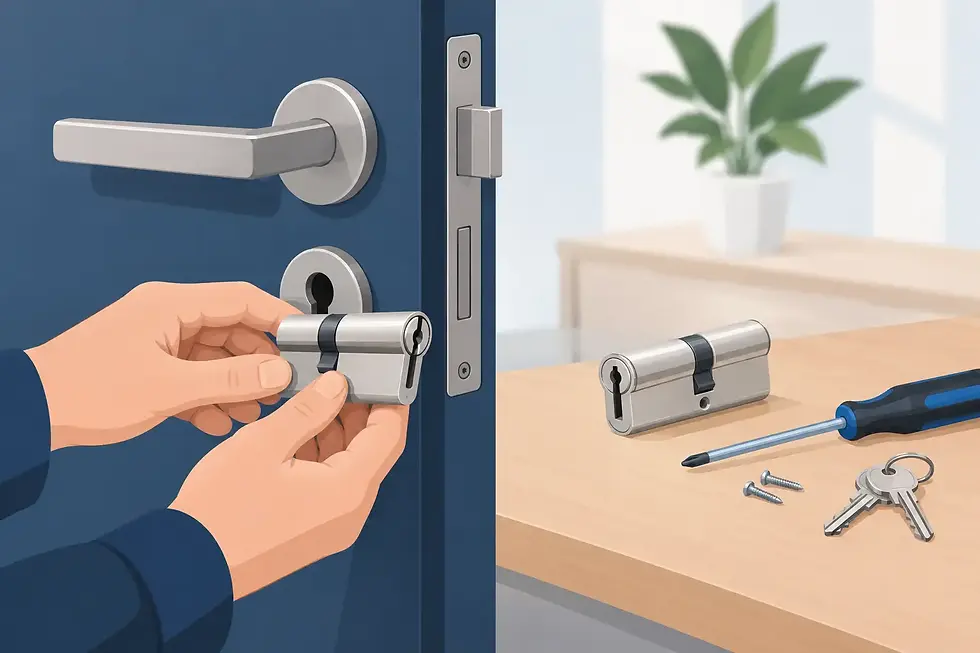
Rekeying changes the internal pin configuration of a lock so old keys no longer work. It is usually a practical option after employee turnover, a lost key, a tenant change, or a contractor relationship ends. Replacement is more appropriate when the hardware is worn, damaged, outdated, incompatible with the planned key system, or not suitable for commercial use.
A master key system can reduce the number of keys carried by managers and maintenance staff. It should be planned carefully. The convenience of one key opening multiple doors also increases the impact if that key is lost. Limit master-level keys to people who truly need them, maintain a documented issue log, and use a controlled key system where appropriate.
A simple written policy helps. Record who receives each key or credential, require prompt return at separation, prohibit unauthorized duplication, and review access after role changes. These procedures cost little and can prevent a costly rekeying project later.
Plan for Employee Turnover and Daily Operations
Security upgrades should make life easier for the people responsible for the building. Think through opening and closing routines, delivery access, cleaning crews, temporary workers, contractors, and emergency responders. The best system on paper can fail if it does not match how the facility operates after hours.
For example, a retail business may want employees to enter through a controlled rear entrance before opening, while customers use a front door that remains accessible during business hours. An industrial site may need separate access for office staff, shipping personnel, and service vendors. A medical office may need to protect records and medication storage while keeping patient areas welcoming and accessible.
Electronic access is helpful when schedules change often or when several groups need different permissions. A restricted mechanical key system may be the more practical answer for a small operation with stable staff and only a few doors. There is no need to add technology simply because it is available. The right choice is the one your team can manage consistently.
Know When a Lock Needs Attention
Commercial hardware usually gives warning signs before it fails. A key that sticks, a lever that sags, a deadbolt that requires force, a door that will not latch, or an exit device that feels loose should be addressed promptly. These problems can lead to a lockout, an unsecured entrance, or damage to the lock and door.
Schedule service before a failure interrupts the workday. Regular inspection is especially worthwhile for busy entrances, aluminum storefront doors, high-traffic offices, warehouses, and properties exposed to weather. A technician can adjust alignment, replace worn components, inspect strikes and closers, and identify whether repair or replacement makes better financial sense.
If an exterior door has been forced, do not assume replacing the cylinder is enough. The door frame, strike, hinges, and surrounding glass or sidelights may also need evaluation. Repairing the visible damage while leaving the weak point unchanged can invite another incident.
Build a Practical Upgrade Plan and Budget
A staged plan helps businesses improve security without trying to solve everything at once. Begin with immediate risks: damaged locks, missing keys, unsecured exterior doors, and hardware that interferes with safe egress. Next, address key control and high-value areas. Then consider longer-term improvements such as access control, master key planning, door operators, safes, and perimeter security.
When comparing estimates, ask what is included beyond the lock itself. Quality installation, door preparation, strike reinforcement, keying, credentials, programming, and future service all affect the real value of the project. A lower initial price can become expensive if the hardware is not compatible with the door or cannot be serviced efficiently later.
For businesses in Oshawa, Whitby, Ajax, Pickering, and across Durham Region, Durham Regional Locksmiths can assess existing commercial doors, recommend practical lock and access options, and provide support when an urgent problem cannot wait. A site assessment is often the fastest way to separate necessary upgrades from hardware that can remain in service.
Your commercial security plan does not need to be complicated. Start with the doors that matter most, control who has access, repair issues before they become failures, and choose hardware that fits the way your business operates every day.