Security Trends That Matter for Property Owners

A misplaced master key, a former employee who still has access, or a side door that never fully latches can create more risk than a dramatic break-in. The security trends affecting homes and businesses are increasingly focused on these everyday weak points: who can enter, when they can enter, and whether the property owner has a clear way to manage that access.
For homeowners, property managers, and business operators, the best upgrade is not always the most complicated one. It is the one that fits the property, the people using it, and the level of risk involved. Physical security still starts at the door, but it now works more closely with better key control, electronic access, stronger hardware, and a plan for responding when something changes.
Security Trends Are Shifting Toward Controlled Access
Traditional keys remain practical, affordable, and dependable. They do not require batteries, an internet connection, or staff training. But a conventional key also leaves little record of who used it, and it can be copied unless the keyway is controlled. That limitation matters when several employees, tenants, contractors, or family members need access.
This is why controlled access has become a central focus. At a home, that may mean a keypad lock on a frequently used entry door, paired with a quality deadbolt. At a business, it may mean card, fob, or credential-based access for staff, with separate permissions for offices, storage rooms, and restricted areas.
The value is not simply convenience. A managed access system can remove a former employee's credentials without changing every lock in the building. It can limit access to certain hours and help identify whether a door was opened after closing. That level of control is especially useful for offices, retail locations, medical facilities, warehouses, and multi-tenant properties.
Electronic access is not automatically the right answer for every opening. A rarely used utility room, a gate exposed to harsh weather, or a small home with only two residents may be better served by a well-installed mechanical lock. The goal is to use technology where it solves a real access problem, not to add complexity for its own sake.
Better Key Control Is Still a Major Security Trend
High-tech access systems get attention, but key control remains one of the most effective ways to reduce preventable security issues. Many properties have more keys in circulation than the owner realizes. A spare may be with a previous tenant, a former cleaner, a contractor, a neighbor, or an employee who left years ago.
Rekeying is often the practical first step after moving into a home, taking over a commercial space, changing staff, or losing a key. It changes the lock's internal configuration so old keys no longer work, without requiring a full replacement of every lock. For a property with several doors, this can be a cost-effective way to restore control quickly.
For businesses, a master key system can provide a more organized structure. A manager may need access to all doors, while employees receive keys only for their assigned areas. The benefit depends on careful planning. A poorly designed system can give too many people broad access, while a properly designed one reduces the number of keys employees need to carry without sacrificing control.
Restricted key systems add another layer. These keys are harder to duplicate through ordinary channels and are issued through authorized providers. They are a strong choice for commercial sites, property managers, and homeowners with higher-value assets. They do require disciplined recordkeeping, because the system only works when key holders and returns are tracked.
Smart Locks Need the Right Door Hardware Behind Them
Smart locks and keypad locks can make daily access easier. Families can assign individual codes instead of hiding a key outside. Property managers can provide temporary codes for approved vendors. Business owners can reduce the rush to collect keys from departing staff.
However, a smart lock does not compensate for a weak door, loose strike plate, poor installation, or damaged frame. Forced-entry resistance comes from the complete opening: the door, frame, hinges, deadbolt, strike, screws, and alignment. A quality lock installed on a poorly secured door is only part of the solution.
Before selecting a smart lock, consider how the door is used. Exterior doors need weather-appropriate hardware and reliable mechanical backup. Doors used by many people need a simple process for adding and deleting users. For rental properties, owners should be clear about who controls the account, codes, and notifications between tenancies.
Battery maintenance is another practical consideration. A low-battery alert is useful only if someone is responsible for responding to it. Properties that need dependable access during emergencies should retain a properly managed mechanical key option or use commercial-grade hardware designed for the environment.
Door and Perimeter Upgrades Deserve More Attention
Many security upgrades focus on the lock cylinder while overlooking the hardware around it. Yet an intruder may target the weakest part of the opening rather than defeat the lock itself. Loose deadbolts, short strike screws, exposed hinges, misaligned doors, and worn closers can all undermine a good locking system.
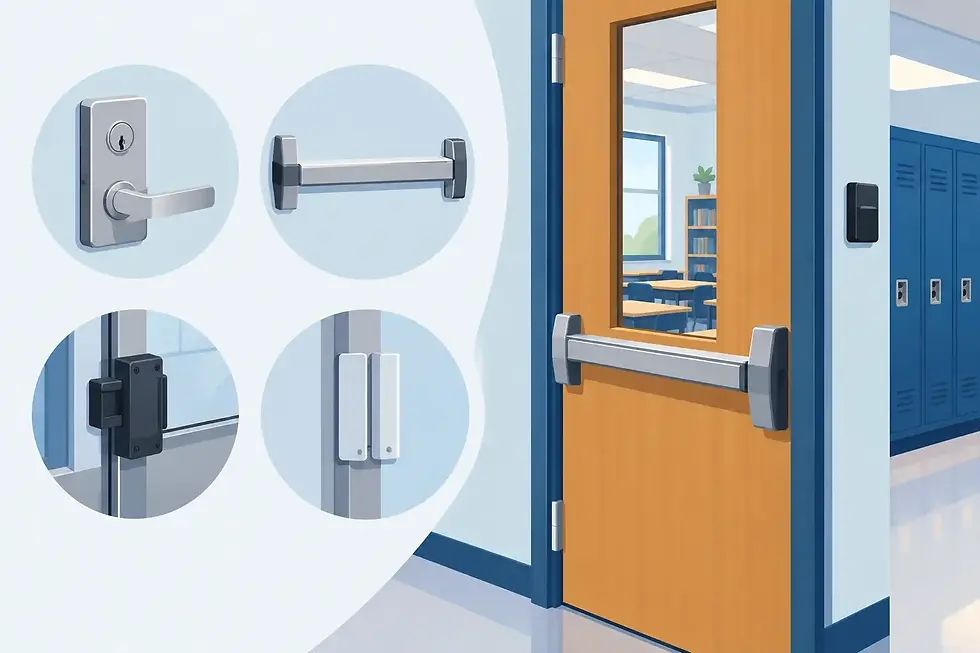
Current physical security trends place more emphasis on reinforcing the entire entry point. Residential properties may benefit from reinforced strike plates, longer screws that anchor into the wall framing, quality deadbolts, and proper door alignment. Commercial sites may need heavy-duty panic hardware, door closers, continuous hinges, access-control-compatible electric strikes, or automatic door operators that are set up to work safely with the locking hardware.
Perimeter security should also match the property's layout. A rear service entrance, delivery door, detached garage, storage shed, or shared hallway can require a different approach than the front entrance. Lighting, sightlines, secure gate latches, and consistent locking procedures often make a meaningful difference before more advanced equipment is considered.
High-Security Locks Are Becoming More Targeted
High-security cylinders and deadbolts are increasingly used where the consequences of unauthorized entry are higher. That can include homes with valuable collections, professional offices handling sensitive records, retail stores with inventory, industrial facilities, and equipment rooms.
These products can offer greater resistance to picking, drilling, bumping, and unauthorized key duplication than basic hardware. Their value depends on the application. Installing a high-security cylinder on a lightly used exterior door can be sensible, but only if the frame and strike are also capable of resisting force. On a commercial site, a high-security lock may be most useful on server rooms, cash offices, medication storage, or other restricted areas rather than every interior door.
The trade-off is cost and administration. Higher-grade hardware generally costs more, and restricted keys need careful issuing and recovery procedures. For many properties, a layered approach is more sensible: stronger protection at critical doors, solid commercial or residential grade locks elsewhere, and clear access rules throughout the building.
Security Trends for Vehicles Focus on Fast, Accurate Service
Vehicle security has changed alongside vehicle technology. Modern keys often include transponders, remote functions, proximity features, or programming requirements that go far beyond cutting a metal key. When a driver loses a key or has an ignition issue, the right solution depends on the vehicle's make, model, year, and security system.
On-site key programming and replacement can save drivers from towing a vehicle or relying solely on dealership service. At the same time, automotive security work should be performed carefully and with proof of ownership. Programming the wrong key or using an incorrect procedure can create costly problems, particularly with newer vehicles.
Drivers can reduce disruption by keeping one tested spare key, replacing weak fob batteries before they fail, and addressing a sticking ignition before it becomes a complete no-start situation. A spare stored securely is more useful than one left inside the vehicle or hidden in an obvious location.
Build a Security Plan That Can Change With You
The strongest trend is not a specific lock, camera, fob, or app. It is the move away from one-time security decisions and toward regular review. Access needs change when people move, staff turns over, a business expands, a tenant leaves, or a property is renovated.
A practical review starts with the doors that matter most: the main entrance, side and rear entries, garage access, offices, storage rooms, and any area holding valuable assets. Check whether each door closes and latches properly, who has a key or credential, whether old access should be removed, and whether the hardware matches the level of use.
For properties across Oshawa, Whitby, Ajax, Pickering, and the wider Durham Region, Durham Regional Locksmiths can assess urgent lock concerns as well as longer-term access and hardware needs. The right recommendation should be based on the door, the building, and the people using it, not a one-size-fits-all package.
Security works best when it is easy to maintain and difficult to overlook. Start with the access you cannot account for, the doors that do not operate properly, and the spaces where a simple failure would cause the greatest disruption.