.png)


Rekeying vs Replacing Locks: Which Fits?

You get home, look at the lock, and realize the real question is not whether it still turns. It is whether you should trust it. When people compare rekeying vs replacing locks, they are usually dealing with one of three situations: a move, a lost key, or a lock that no longer feels secure.
The right answer depends on what changed. If the hardware is still in good shape, rekeying can be the faster and more cost-effective move. If the lock is worn out, damaged, outdated, or no longer matches your security needs, replacement may be the better investment.
Rekeying vs replacing locks: what is the difference?
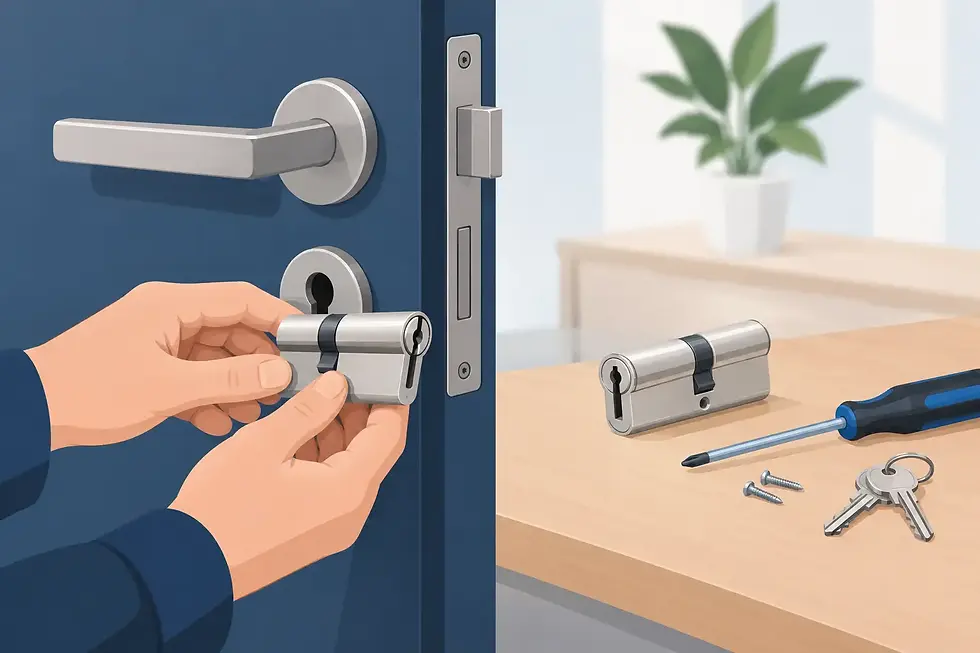
Rekeying changes the internal pins inside a lock so the old key no longer works. The lock stays in place, but it is adjusted to work with a new key. From the outside, nothing may look different, but access has changed.
Replacing a lock means removing the existing hardware and installing a new lock. That could mean a similar model, a stronger grade of lock, a different style, or a complete upgrade to higher-security hardware.
This distinction matters because the job, the cost, and the result are different. Rekeying is mostly about controlling who has access. Replacing is about changing the actual hardware, often to solve a mechanical problem or improve security.
When rekeying makes more sense
Rekeying is often the best choice when the lock itself is working properly and your main concern is key control. This is common after moving into a new home, when a tenant moves out, after a breakup, or any time keys may have been copied, shared, or not returned.
For homeowners, rekeying is a practical way to start fresh without changing every lock on the door. If the deadbolt and knob are in good condition, there is usually no reason to replace them just because old keys are floating around somewhere.
For property managers and business owners, rekeying can also help restore control quickly after staffing changes or turnover. It is often less disruptive than swapping out multiple locks, especially on buildings with several doors.
Another advantage is key consolidation. In some cases, multiple locks can be rekeyed to work with one key, which is useful for homes with several entry points or businesses trying to simplify day-to-day access.
Good candidates for rekeying
A lock is usually a good candidate for rekeying when the hardware is intact, the keyway is serviceable, and there is no major wear affecting reliability. If the lock turns smoothly, latches correctly, and still provides an acceptable level of security, rekeying can solve the immediate access issue without unnecessary hardware replacement.
That said, rekeying is not a cure for a bad lock. If the lock sticks, binds, wobbles, or shows signs of internal wear, changing the key alone will not fix the mechanical problem.
When replacing locks is the better call
Replacing makes more sense when the hardware has become the problem. If a lock is damaged after a break-in attempt, visibly worn, rusted, loose, or unreliable, replacement is usually the safer decision.
There is also the issue of outdated security. Some older locks still function, but they no longer provide the level of protection most owners want. If the lock is low-grade, easy to bypass, or missing features you need, replacement gives you a chance to upgrade instead of just resetting access.
This is especially relevant for commercial doors, multi-unit properties, and homes where better key control matters. Higher-security cylinders, restricted key systems, reinforced deadbolts, and access control hardware all require replacement rather than a simple rekey in many cases.
Style can matter too. If you are changing door hardware finishes, moving from a standard lock to a smart lock, or matching hardware across a property, replacement is the only route.
Signs a lock should be replaced
A lock that feels inconsistent is often telling you something. If you have to jiggle the key, push the door hard to get it to latch, or deal with a cylinder that turns roughly, the issue may be wear, misalignment, or failing internal components. In those cases, replacing the lock can prevent a future lockout or security failure.
After forced entry, replacement is usually the right move even if the lock still operates. Visible damage does not always tell the whole story, and compromised hardware should not be trusted just because it still turns once or twice.
Cost is part of it, but not all of it
Rekeying is usually less expensive than replacing because you are keeping the existing hardware. That makes it attractive when several locks need attention at once, especially after moving or taking over a property.
But the cheapest option is not always the best long-term option. If you rekey a lock that is already near the end of its service life, you may end up paying again soon for replacement. In that situation, replacement may actually be the more practical value.
A good locksmith will usually look at both the access issue and the condition of the hardware before recommending one path. That matters because the smartest answer is often based on whether the current lock is worth keeping.
Security goals change the decision
Not every lock problem is really a lock problem. Sometimes it is a security planning problem.
If your goal is simply to make old keys useless, rekeying may be enough. If your goal is to improve resistance to picking, bumping, forced entry, or unauthorized key duplication, replacement is often the stronger move because it opens the door to better hardware.
For businesses, this can extend beyond standard lock cylinders. A growing office, medical facility, retail location, or industrial site may need master key capability, controlled keyways, or electronic access rather than another round of basic rekeying. For those environments, a replacement may be part of a larger security upgrade rather than a one-time fix.
Rekeying vs replacing locks for new homeowners
New homeowners often assume they need all new locks right away. Sometimes they do, but not always.
If the existing locks are quality hardware in good condition, rekeying is often the right first step. It cuts off prior access quickly and keeps costs reasonable while you settle into the property. If the locks are builder-grade, damaged, mismatched, or simply not giving you confidence, replacement is usually worth it.
This is one of the most common it-depends situations in locksmith work. The house may be new to you, but the hardware may still be perfectly usable. Or it may be exactly the time to upgrade.
What about businesses and multi-door properties?
Commercial properties usually need a more careful review. Rekeying one office door is simple. Rekeying an entire site with shared access, employee turnover, and multiple departments is more strategic.
In some buildings, rekeying is the right immediate response after a staffing change or lost key. In others, recurring turnover means a restricted key system or master key redesign makes more sense than repeated service calls. Replacing hardware can also be necessary when code compliance, door function, or security grades need to be addressed.
For property managers, the decision often comes down to balancing turnover costs, reliability, and liability. If the existing hardware is decent and the issue is access control, rekeying is efficient. If maintenance teams are constantly dealing with worn locks or tenant complaints, replacement usually solves more than one problem at once.
How a locksmith decides
A professional locksmith typically looks at the lock type, brand compatibility, physical condition, and your actual security concern. Not every lock can be rekeyed easily, and not every replacement is worth doing if a rekey solves the problem just as well.
The best recommendations are usually straightforward. Keep good hardware if it still serves your needs. Replace weak or failing hardware when it no longer does.
That practical approach is what people want from a local locksmith service. Whether it is a home, storefront, rental unit, office, or industrial site, the goal is not to sell the bigger job. The goal is to leave you with secure, dependable access.
If you are weighing rekeying against replacement, the simplest test is this: are you trying to change who has a key, or are you trying to change the quality of the lock itself? Once that is clear, the right next step usually becomes clear too.
A solid lock should give you confidence every time you use it. If it does not, that is the moment to fix the problem properly, not just temporarily.